Scroll Percentage: 0%
Partner Project: Global Environment Facility
Since 2024, the Fund has partnered with the Global Environment Facility (GEF) to support emerging conservation leaders in developing countries through the Fonseca Field Grants.
For more than three decades, GEF has been a leading source of environmental finance, providing more than US$27 billion in grants and mobilising over US$155 billion in co-financing for environmental initiatives across more than 170 countries. Its support for biodiversity, climate action and sustainable development has made it a cornerstone of global environmental cooperation.
The Fonseca Leadership Program, established in memory of the late Gustavo Fonseca, a respected leader in global conservation and GEF's long-serving Director of Programs, reflects a shared commitment to empowering the next generation of conservation leaders.
The partnership continues to grow, supporting conservationists to protect species, strengthen ecosystems and build lasting conservation solutions. In 2025 alone, the collaboration supported 66 projects across [XX] developing countries, with approximately 40% led by women conservationists.
This collaboration demonstrates the power of partnership to turn local conservation leadership into lasting impact for nature.
The Fund supported 66 emerging conservationists in 2025.
Use the menu below to scroll to a few select testimonials:
- Eduardo Reyes Grajales
- Daniela Torres
- Akovognon Jérôme Dohou
- Verawati Ayu Lestari
As pressures on nature continue to grow, partnerships like this enable us to act with greater scale, speed, and impact.
H.E. Razan Al Mubarak
Managing Director
Mohamed bin Zayed Species Conservation Fund
Case study 1
Grant recipient: Eduardo Reyes Grajales
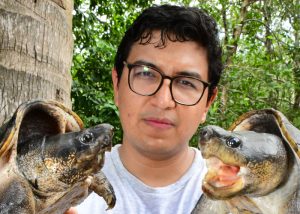
Eduardo Reyes Grajales dedicated his life to the conservation of reptiles around the world while working on his PhD in ecology and sustainable Development he is also the project lead of the Turtle Survival Alliance’s (TSA) current conservation project in Chiapas, Mexico. Since 2001, TSA’s primary mission is to protect and restore wild populations of tortoises and freshwater turtles, such as the Pacific Coast Musk Turtle (Staurotypus salvinii)
Project:
The Pacific Coast Musk Turtle (Staurotypus salvinii) home range stretches along the Americas’ Pacific coast from Oaxaca, Mexico to El Salvador and is one of the least studied freshwater turtles in the world. The species was believed to be near threatened until 2023, when its IUCN classification jumped to that of endangered after habitat loss, pollution, and overexploitation from hunters and the pet trade had decimated the population.
With knowledge gaps stalling effective conservation efforts, Eduardo Reyes Grajales and his team studied the turtle’s ecology, habitat use, and reproduction to create more targeted methods. Their findings, like the turtle’s preferred nesting conditions, were curated for two manuscripts that are awaiting publication and will shape future conservation efforts.
Pacific Coast Musk Turtle
Staurotypus salvinii
Endangered
North America
Mexico
$14,100.00
The Fonseca Leadership Grant has been an invaluable opportunity to grow as an emerging conservationist while contributing directly to the conservation of the Pacific Coast Musk Turtle (Staurotypus salvinii) in coastal Chiapas, Mexico. The support allowed us to work closely with local communities, strengthen their capacity to monitor the species, and generate valuable information about its populations and conservation needs. Beyond the data collected, the project helped build local knowledge, engagement, and ownership around the conservation of this little-known turtle. For me, this experience has reinforced the importance of combining scientific research with community participation to develop meaningful and lasting conservation actions.
Eduardo Reyes Grajales
Project Lead
Turtle Survival Alliance
Case study 2
Grant recipient: Ms Daniela Torres
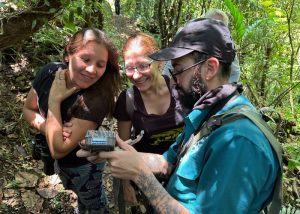
Daniela Torres began her time at the Fungi Foundation as a volunteer in 2014 and has since risen through the ranks, becoming the program lead and director of the Chilean office. Together with the organisation, she works to fill the knowledge gap about this understudied kingdom and promote its conservation through education and working with public policy to create effective conservation methods.
Project:
Grifola gargal is a fungus particularly associated with the Nothofagus forests where plays the role as a key decomposer of the Patagonian oak (Nothofagus obliqua), Chiloé’s coigue (Nothofagus nitida), and Magellan’s beech (Nothofagus betuloides). This endangered mushroom has long been sought after for its taste, but additional pressures like deforestation, grazing, and infrastructure developments — namely hydroelectric power and electrical networks — have had a significant impact on the population.
With no active nor official conservation plan in place, Daniela Torres and her team at the Fungi Foundation have been leading planning efforts by orchestrating key stakeholder interviews and workshops to develop population assessment methods for the under-researched species. Their goal remains to design a conservation plan that meets the requirements of a RECOGE Plan, so it can be ratified for official adoption and implementation.
Grifola
Grifola gargal
Endangered
South America
Chile
$16,000.00
Grifola gargal is a native fungus species from the South and Patagonia of Chile and Argentina It is renowned for its exquisite aroma and unique flavor. This fungus is part of the decomposition chain of old-growth forests, one of the most threatened ecosystems in recent years; its habitat is associated with the dead wood of ancient trees. Thanks to the support of the MBZ Species Conservation Fund, the Fungi Foundation is developing a Conservation Plan to protect this species and its habitat, integrating a social dimension through the experience of local communities, a scientific dimension with mycologists from Chile and Argentina, and a public policy dimension involving decision-makers.
Daniela Torres
Project Lead
Fungi Foundation
Case study 3
Grant recipient: Akovognon Jérôme Dohou
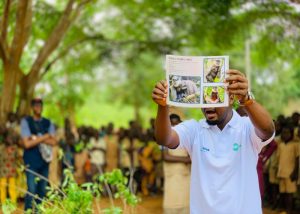
Mr Akovognon Jérôme Dohou Joined the Coordination for Environmental Research and Development (CoRDE-ONG) in 2023, shortly after completing his masters in Natural Resource Management, where he has since been active as a biodiversity and climate change officer, working with the local community to protect the Red-Bellied Monkey in the Hlanzoun Community Forest in Benin.
Project:
The Red-Bellied Monkey (Cercopithecus erythrogaster erythrogaster) is an endemic primate of West Africa found throughout the fragmented forests of Nigeria, into southern Benin. Listed as critically endangered by the IUCN, the Red-Bellied Monkey’s numbers have been in steep decline as population growth has placed significant pressure on them through deforestation, habitat fragmentation, and bushmeat hunting.
Dohou and his team at CoRDE-ONG are trying to change the relationship between the local communities and the Red-Bellied Monkey. Aiming for peaceful coexistence, they changed the community’s perception through education, developing sustainable income-generating actives, and teaching new farming techniques that would stop soil degradation and thereby, deforestation. These efforts were paired with monitoring and anti-poaching work that saw ten new guards join the ongoing fight for the Red-Bellied Monkey.
Red-Bellied Monkey
Cercopithecus erythrogaster erythrogaster
Critically endangered
Africa
Benin
$9,800.00
The Fonseca Leadership Grant has been much more than financial support. It has been an opportunity to grow as an emerging conservation leader, turn my ideas into concrete actions, and work alongside local communities to protect threatened biodiversity. It has strengthened my confidence, leadership, and commitment to building long-term conservation solutions in Benin.
Akovognon Jérôme Dohou
Project Coordinator
Act for Sustainable Actions
Case study 4
Grant recipient: Verawati Ayu Lestari
Project:
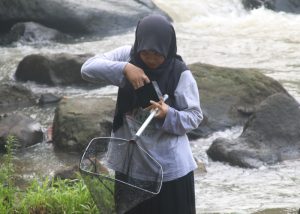
Oryzias wolasi
Oryzias wolasi
Data Difficient
Asia
Indonesia
$4,960
The support from the MBZ Fund has been essential in enabling us to take concrete steps in freshwater conservation, particularly in strengthening the capacity of young people at the local level. In a time of increasing environmental challenges, this support is vital to ensure that conservation efforts remain active and impactful.